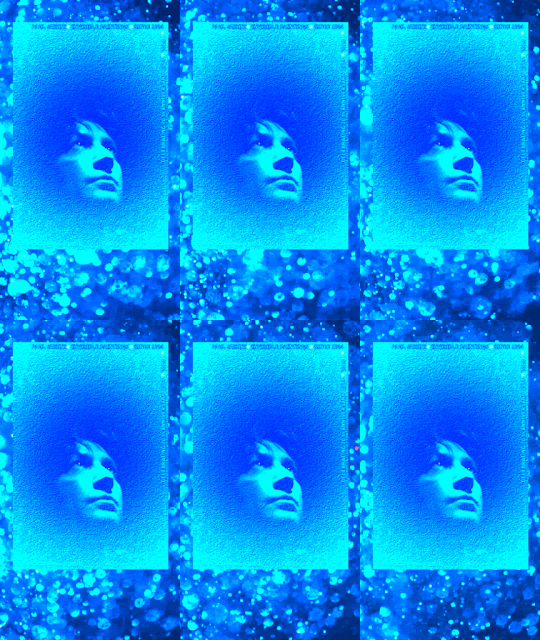
Blue Reincarnation Narcissus by Jaisini
The theme of Narcissus in Jaisini's "Blue..." may be paralleled with the problem of the two-sexes-in-one, unable to reproduce and, therefore, destined to the Narcissus-like end. Meanwhile, the Narcissus legend lasts.
In the myth of Narcissus a youth gazes into the pool. As the story goes, Narcissus came to the spring or the pool and when his form was seen by him in the water, he drowned among the water-nymphs because he desired to make love to his own image.
Maybe the new Narcissus, as in "Blue Reincarnation," is destined to survive by simply changing his role from a passive man to an aggressive woman and so on. To this can be added that, eventually, a man creates a woman whom he loves out of himself or a woman creates a man and loves her own image but in the male form. The theme of narcissism recreates the 'lost object of desire.' "Blue" also raises the problem of conflating ideal actual and the issue of the feminine manhood and masculine femininity.
There is another story about Narcissus' fall which said that he had a twin sister and they were exactly alike in appearance. Narcissus fell in love with his sister and, when the girl died, would go to the spring finding some relief for his love in imagining that he saw not his own reflection but the likeness of his sister. "Blue" creates a remarkable and complex psychopathology of the lost, the desired, and the imagined. Instead of the self, Narcissus loves and becomes a heterogeneous sublimation of the self. Unlike the Roman paintings of Narcissus which show him alone with his reflection by the pool, the key dynamic in Jaisini's "Blue" is the circulation of the legend that does not end and is reincarnated in transformation when autoeroticism is not permanent and is not single by definition.
In "Blue," we risk being lost in the double reflection of a mirror and never being able to define on which side of the mirror Narcissus is. The picture's color is not a true color of spring water. This kind of color is a perception of a deep seated human belief in the concept of eternity, the rich saturated cobalt blue.
The ultrahot, hyperreal red color of the figure of Narcissus is not supposed to be balanced in the milieu of the radical blue. Jaisini realizes the harmony in the most exotic color combination. While looking at "Blue," we can recall the spectacular color of night sky deranged by a vision of some fierce fire ball. The disturbance of colors create some powerful and awe-inspiring beauty.
In the picture's background, we find the animals' silhouettes which could be a memory reflection or dream fragments. In the story, Narcissus has been hunting - an activity that was itself a figure for sexual desire in antiquity. Captivated by his own beauty, the hunter sheds a radiance that, one presumes, reflects to haunt and foster his desire. The flaming color of the picture's Narcissus alludes to the erotic implications of the story and its unresolved problem of the one who desires himself and is trapped in the erotic delirium. The concept can be applied to an ontological difference between the artist's imitations and their objects. In effect, Jaisini's Narcissus could epitomize artistic aspiration to control levels of reality and imagination, to align the competition of art and life, of image with imaginable prototype.
Jaisini's "Blue" is a unique work that adjoins reflection to reality without any instrumentality. "Blue" is a single composition that depicts the reality and its immediate reflection. Jaisini builds the dynamics of desire between Narcissus and his reflection-of-the-opposite by giving him the signs of both sexes, but not for the purpose of creating a hermaphrodite. The case of multiple deceptions in "Blue" seems to be vital to the cycle of desire. Somehow it reminds one of the fate of the artists and their desperate attempts to evoke and invent the nonexistent.
"Blue" is a completely alien picture to Jaisini's "Reincarnation" series. The pictures of this series are painted on a plain ground of canvas that produces the effect of free space filled with air. "Blue," to the contrary, is reminiscencent of an underwater lack of air; the symbolism of this picture's texture and color contributes to the mirage of reincarnation.
"Blue Reincarnation" (Oil painting) by Paul Jaisini
New York 2002, Text Copyright: Yustas Kotz-Gottlieb
ALL RIGHTS RESERVED
Send private comments to author


 Glimpsing to see the future in the "crystal ball" may be startling for the creator. She faces the truth with calm wisdom, inspired to bring order out of chaos, will create chaos out of order. Her will to create is stronger then fear of limitations and unknown. The future is in the process of being formed not jelled enough to be fully predicted and interpreted.